You probably know less than you think. So do your customers.
Quick question before we start. You put €100 in a savings account that pays 2% a year, with no fees, and you leave it there. After five years, is there more than €110, exactly €110, or less than €110?
Hold on to your answer, and to how sure you felt.
The European Commission asked that question, and four others like it, in all 27 member states(1). It also asked people how much they knew about money. In Romania, 51% said very high or fairly high, the most confident result in the EU. The EU average was 30%. Then came the test. Across the EU, 26% got four or five questions right. In Romania, 13% did.
Same people, same questionnaire.
If you hesitated for a second over the savings question, you have already felt what this post is about: the gap between feeling sure and being right.
Psychologists have been studying this gap since Justin Kruger and David Dunning’s 1999 paper(2), which found that the people who score lowest on a test tend to overrate themselves the most. Later studies went further. They show when the gap opens, when it grows, and what makes it smaller. Your customers go through every one of those stages.
It starts before they buy. In one study, the people who rated their finance knowledge highest were the most likely to claim they knew terms that do not exist, such as “pre-rated stocks” and “annualized credit”(3). So a customer who nods through your sales conversation has told you very little. Ask them how it works. In 2013 Philip Fernbach and his colleagues asked people to explain, step by step, how a policy they had strong views on would actually work(4). Their rated understanding dropped, and their views became more moderate. A second group listed reasons for their view and barely moved. The difference was the word ‘how’.
Five how-questions about your product will tell you where you stand. How does it actually get you the result you bought it for? How much of this is your job, and how much is ours? How much will it cost you over a year? How do you check that it works as expected? How would you explain it to a colleague who is about to buy it? Ask them a month after the sale, and listen for where the explanation breaks. Better still, write your own five, starting from the questions your support team hears most.
That first month matters for another reason. Carmen Sanchez and David Dunning found that people learning something new are not overconfident at the very start(5). They become overconfident after a few early successes, once they have a simple theory of how things work and nothing has broken it yet. The researchers call it the beginner’s bubble: a stretch where confidence runs well ahead of skill, until later mistakes slow it down.
With a product, that stretch starts a little after onboarding, once the customer has used it a few times and it has worked. That is when they change the setting they half understand, skip the clause that applied to them, and stop reading your emails. So use those first few weeks to remind them of what matters, in places they cannot skip. Show the yearly cost next to the monthly one on every invoice. Send the reminder about the cancellation window in the week it closes. Turn the step people most often get wrong into a choice they have to make, with nothing pre-selected.
Experience will not sort it out later. Even tournament chess players, who get a precise rating after every game, still overrate themselves, and the least skilled overrate themselves the most(6). So do not expect the monthly statement or usage reports to set your customers straight either.
Your own team runs on the same pattern. Ask three people, one each from sales, support and finance, to explain your pricing, your margins or your main competitor’s offer, step by step and without notes. Then ask how well they think they know it. Make it a ten-minute exercise in your next team meeting, and go first.
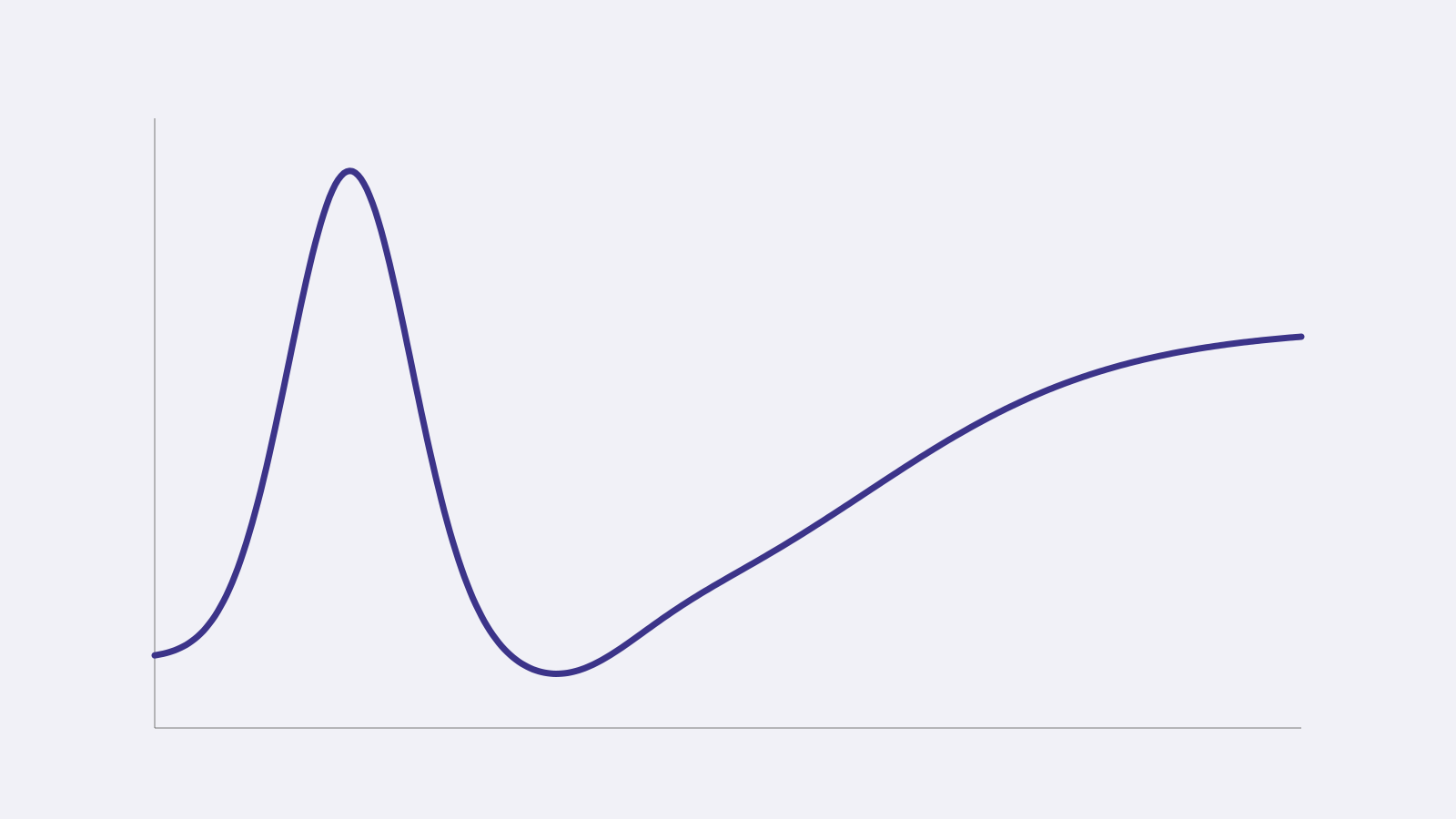
There is a twist in the research itself. The most famous picture of the Dunning-Kruger effect, a curve that climbs to a peak of confidence nicknamed “Mount Stupid” and drops into a “valley of despair”, appears nowhere in the 1999 paper. It came later, from the internet, and is now what most of us are sure the study says. Some statisticians go further and argue that much of the original pattern is a side effect of how such tests are scored(7). The argument is still running. Even the study of overconfidence has its confident disagreements. The Romanian result stands either way, because it compares the same people’s self-ratings with their own test scores.
The researchers will keep arguing. Your customers will keep nodding. Five questions about how your product works will tell you more than either.
P.S. About that €100 in the savings account: after five years it holds €110.41, because the interest also earns interest. So the answer is more than €110. 45% of Europeans got it right, and 38% of Romanians. If you answered “exactly €110”, you are in the majority: more than half of Europeans did not get it right either.
A note on the data: the Eurobarometer survey was carried out in 2023 and is still the latest EU-wide measure. The Commission built its 2025 financial literacy strategy on it, and the next round is due in 2027(8).
Further reading
- European Commission, “Monitoring the level of financial literacy in the EU,” Flash Eurobarometer 525, July 2023.
- Justin Kruger and David Dunning, “Unskilled and Unaware of It,” Journal of Personality and Social Psychology, vol. 77, 1999. Summary and resources: University of Michigan.
- Stav Atir, Emily Rosenzweig and David Dunning, “When Knowledge Knows No Bounds,” Psychological Science, 2015. Summary: Association for Psychological Science.
- Philip Fernbach, Todd Rogers, Craig Fox and Steven Sloman, “Political Extremism Is Supported by an Illusion of Understanding,” Psychological Science, 2013.
- Carmen Sanchez and David Dunning, “Overconfidence Among Beginners: Is a Little Learning a Dangerous Thing?,” Journal of Personality and Social Psychology, vol. 114, 2018.
- Patrick Heck, Daniel Benjamin, Daniel Simons and Christopher Chabris, “Overconfidence Persists Despite Years of Accurate, Precise, Public, and Continuous Feedback,” Psychological Science, 2025. Summary: Association for Psychological Science.
- Jan Magnus and Anatoly Peresetsky, “A Statistical Explanation of the Dunning–Kruger Effect,” Frontiers in Psychology, March 2022.
- European Commission, “Communication on a Financial Literacy Strategy for the EU,” COM(2025) 681, 30 September 2025.
Leave a Reply