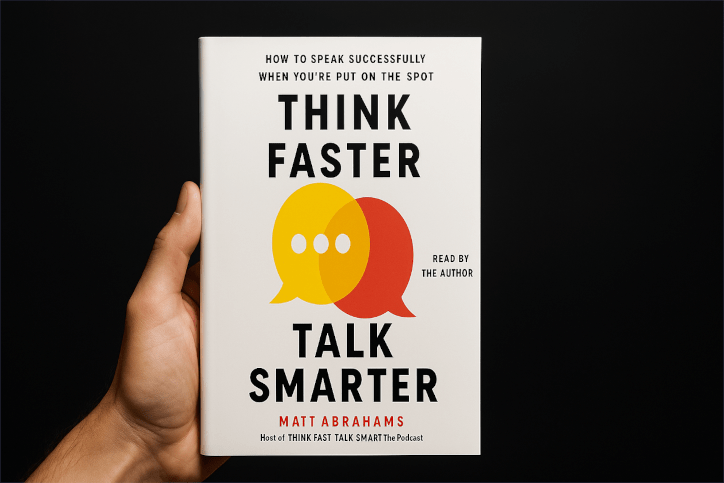
I first came across Matt Abrahams as Guy Kawasaki’s guest on the Remarkable People podcast(1), where he explained how preparation is what makes you think faster and talk smarter when the moment comes. He spoke about managing anxiety, reframing challenges as opportunities, and using structured approaches to deliver responses that feel spontaneous yet impactful. That conversation was convincing enough to buy his book(2) and place it on the “read next” pile beside my bed. I finally opened it this summer, on the beach with my son, halfway succeeding at a digital detox. It turned out to be the perfect setting for a book about presence.
The premise of Abrahams’s work is simple enough: spontaneity can be trained. Just like discipline or attention, it grows with practice. A pause buys you time and authority. A simple framework rescues you when your mind goes blank. People rarely remember polish; they remember clarity. And what looks natural on stage or in a meeting is usually the product of hours of preparation. Abrahams mentions Steve Jobs, whose keynote presentations felt effortless yet were rehearsed to the smallest detail. Spontaneity, in other words, is about building the muscle memory that frees you to respond with ease when the script disappears. And if Jobs, someone with natural charisma and presence, kept training, what should the rest of us expect?
I’m not a fan of most self-help books, yet Abrahams’s stood out for its practicality. He lays out frameworks for almost every situation. In the office, PREP (Point → Reason → Example → Point) gives you a clean arc to keep your thoughts organized. For pitching, the classic Problem → Solution → Benefit frame keeps you focused on value. When you need to weigh options, Comparison → Contrast → Conclusion forces you to look at both sides before landing your message. For storytelling, there’s STAR (Situation → Task → Action → Result), a compact way to describe what happened and what came out of it. And for feedback, the Four I’s (Information → Impact → Invitation → Implications) give you a way to stay constructive and clear.
My favorites, though, are the ones that work outside the office. What → So What → Now What saves me from myself when I fall back on the worst question for my teenage son: “How was your day?” He answers “Good” and that’s it. I understood that the real problem isn’t him giving me a short answer, but it’s me starting in the wrong place. This little frame pushes the talk further: share something, explain why it matters, then point to what comes next. For apologies, Abrahams offers AAA (Acknowledge → Appreciate → Amend): admit what went wrong, recognize the impact, and spell out how you’ll make it right. No more “I’m sorry if you got your feelings hurt by what I said” when I need to apologize to my better half, I promise.
Reading through these frameworks, I recalled Andreessen(3) suggesting that AI could read and digest books for us, making the act of reading less necessary. Clever in theory, but it misses something essential. A book like Abrahams’s delivers more than acronyms and bullet points. The stories, the context, the way ideas unfold and repeat, that’s what makes them stick. You don’t absorb presence or structure from a compressed summary. You absorb them by spending time with the words, letting the rhythm of the book reshape how you think. AI can hand you information; it cannot hand you the experience of discovery. And as previously explained, the more we let AI think for us, the more vital it becomes to keep our own critical faculties in shape. And reading is one of the simplest, most effective ways to do that.
Whether it’s inbox FOMO, discipline gaps, or the attention maps inside teams, the thread running through those posts is simple: good work relies on good practices. Not grand strategies, but small routines that hold under pressure. Abrahams’s frameworks fit right in: practical anchors you can reach for when your instinct is to freeze, ramble, or over-explain.
On the beach I never reached full detox. I still checked my inbox more than I wanted. My son also wrestled with his phone, yet he managed to finish his summer math assignment, a different kind of victory. I finished the book, he finished his work. Neither of us unplugged completely, yet we both walked away with something worthwhile. That feels like progress. And it’s worth trying again, because every small win makes the next one easier.
References & Further Listening/Reading
(1) Guy Kawasaki — Remarkable People Podcast, Episode with Matt Abrahams
(2) Matt Abrahams — Think Faster, Talk Smarter: How to Speak Successfully When You’re Put on the Spot
(3) Marc Andreessen — Why AI Will Save the World
(*) Matt Abrahams — Think Fast, Talk Smart Podcast
(*) Matt Abrahams — Official Website
 Florin Branici
Leave a comment